The Dinner Bell: How Your Cat Trained You to Serve on Command
Biscuit rings a brass service bell when he wants dinner. The real science behind feline food demands — from the cry hidden inside the purr to the psychology of the bell — and how to take back mealtimes without breaking the bond.
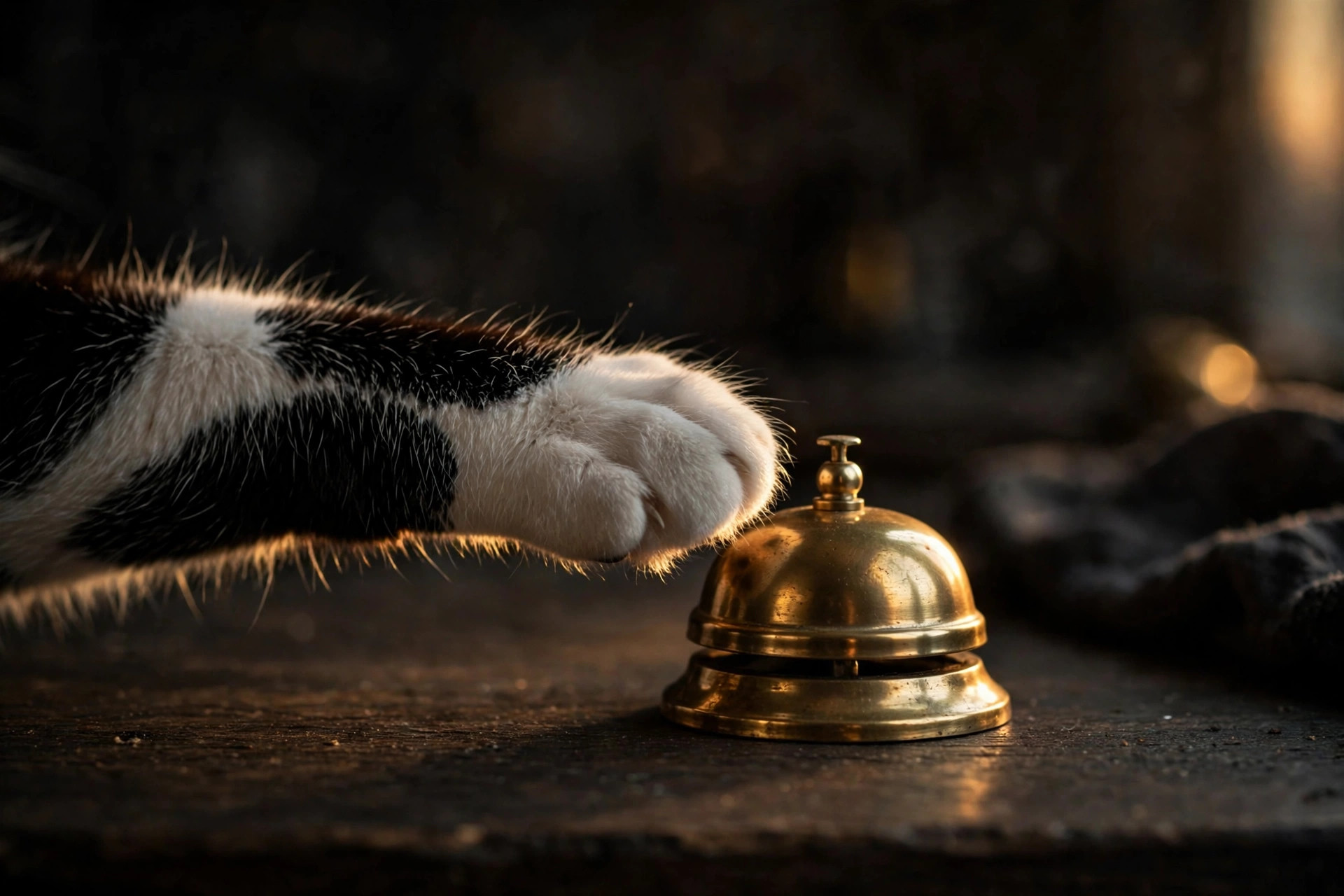
Every evening at half past six, a small brass bell rings in my kitchen. It is not rung by a butler. It is rung by a paw — black and white, slightly impatient — belonging to Biscuit, a tuxedo cat who has decided that dinner is a room-service affair.
Here is the part that should embarrass me: the bowl is usually full. Biscuit does not ring because he is hungry. He rings because ringing works. Somewhere along the way, without either of us signing a contract, my cat conducted a flawless training program — and I was the student.
If this sounds familiar, it should. Nearly every cat owner alive is enrolled in the same course. The good news is that science has been quietly auditing the curriculum, and what researchers have found is more impressive than any of us expected. Your cat is not just being dramatic. Your cat is running acoustic warfare and behavioral psychology on you — and doing it brilliantly.
The Voice Was Built for You
Start with the meow: the most familiar sound in the domestic cat's arsenal, and possibly the most misunderstood. Adult cats rarely meow at each other. Feral cats, living without humans, barely meow at all. The meow, researchers believe, is essentially a kitten behavior that domestic cats never outgrew — kept, refined, and aimed squarely at the one species that responds to it: us.
Cats even tune it for the audience. Studies of feline vocalization have found that cats pitch their voices higher when addressing humans than when addressing other cats, landing in a frequency band strikingly close to that of a crying human infant. Your brain, wired by evolution to snap to attention at an infant's distress call, cannot fully ignore it. That 5 a.m. concert outside your bedroom door is not an accident of nature. It is a precision instrument.
And then there is the purr — or rather, the purr's evil twin. In 2009, researcher Karen McComb at the University of Sussex set out to understand why some purrs feel impossible to ignore. She recorded ten cats purring in two contexts: while actively soliciting food, and while resting or being petted. Fifty listeners rated the food-soliciting purrs as significantly more urgent and less pleasant — and they could tell the difference even if they had never owned a cat, though cat owners were sharper at it.
The acoustic analysis revealed the trick: hidden inside the low, soothing rumble was a high-frequency cry, peaking around 220–520 hertz — squarely in the band of a human infant's wail. When McComb digitally removed that embedded cry, leaving everything else identical, listeners could no longer distinguish the food purr from the contented one. The cry was the entire message. Published in Current Biology, the study suggests cats may be exploiting a deep mammalian instinct — our hardwired response to offspring in distress — to get the bowl filled.
Read that again: your cat has, in effect, learned to counterfeit a baby's cry inside a lullaby. Next to that, Biscuit's bell is almost honest.
The Bell Is Just Textbook Psychology
Which brings us back to the brass bell on my kitchen counter. I did not teach Biscuit to ring it — not deliberately, anyway. One evening he batted it off the counter, it rang, and I, delighted, produced a treat. In the language of behavioral science, that was a completed trial of operant conditioning: an action, followed by a reward, followed by a permanent change in behavior.
Cats are superb at this kind of learning. An action that produces food gets repeated; an action that produces nothing gets dropped. The bell was simply the most reliable lever Biscuit ever found. And here is the uncomfortable symmetry: every time I answered its ring, I was not training my cat. My cat was training me — each prompt delivery of dinner reinforcing my response to the bell, the meow, the stare.
There is a darker wrinkle, and it explains why these behaviors are so hard to undo. Behavioral science has long documented the partial reinforcement effect: a behavior rewarded only sometimes — the ignored meow, the occasional midnight treat — becomes more persistent, not less. It is the same mechanism that keeps people pulling slot machine levers. Every time you hold out for an hour and then cave, you have not taught patience. You have taught that persistence pays.
So no — Biscuit is not spoiled in the way we usually mean it. He is the product of a perfectly consistent education, delivered by an extremely consistent teacher. Me.
Renegotiating the Treaty (Without Dethroning the King)
None of this means surrendering the kitchen forever. It means changing the terms — in a way that respects both the science and the cat.
First, feed the hunter's clock, not the human one. Cats are crepuscular — wired by evolution to hunt at dawn and dusk — and their appetites follow that rhythm. Two structured meals, morning and evening, align far better with feline biology than a bowl that sits full all day or treats dispensed on demand. A predictable schedule also defuses much of the anxiety behind demanding behavior: the cat that knows dinner always comes at six has less reason to campaign at four.
Second, make dinner a job. In the wild, a cat works for every calorie — stalking, chasing, pouncing. A bowl of free kibble is, biologically speaking, deeply weird. Puzzle feeders and food-dispensing toys restore a little of that effort, and a cat that has "hunted" its dinner is a calmer, less demanding cat afterward.
Third — and this is the hard one — stop paying the ransom. When Biscuit rings the bell at 4 p.m., nothing happens now. When he sits quietly at six, dinner appears like clockwork. Reward the calm, not the campaign. It took about two weeks of pointed staring before the message landed. Be warned: the behavior gets worse before it gets better — trainers call it an extinction burst — but consistency wins.
One caveat, and it matters: if your cat's appetite changes suddenly — ravenous when they were casual, or indifferent when they were keen — that is a veterinary conversation, not a training project. Appetite shifts can signal real medical issues, and no behavioral framework replaces a checkup.
Biscuit still has his bell. It still rings at half past six, sharp enough to set a watch by. The difference is that now we both know what it means: not a demand, but an appointment. The tyrant keeps his crown. The staff simply negotiated better hours.
The royal decree, in short
- The "solicitation purr" hides a baby-like cry (220–520 Hz) inside a soothing rumble — Karen McComb, University of Sussex, 2009.
- Demanding behavior is operant conditioning: rewarded actions get repeated — by the cat, and by you.
- Giving in sometimes (partial reinforcement) makes the behavior stronger, not weaker.
- Renegotiate with structured dawn/dusk meals, puzzle feeders, and rewarding calm — expect an extinction burst first.
- Sudden appetite changes mean a vet visit, not a training project.